
Tintin in the Congo
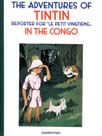
- Black & white facsimile. Original version. (First English edition cover shown). Hardback.
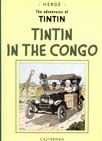
- Black & white facsimile. Original version, plus 4 colour plates. Hardback.
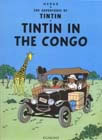
- Colour edition / 1946 re-drawn version. Hardback.
- Tintin © Hergé/Moulinsart.
Original French title
Tintin au Congo
Publication history
First published in Le Petit Vingtième between 5 June 1930 and 11 June 1931.
Published in book form in 1931 (black and white, 110 pages).
Redrawn and published in colour in 1946.
Further changes made in 1975.
English edition
1991 - Sundancer (London). Translated by Leslie Lonsdale-Cooper and Michael Turner. Black and white facsimile. Hardback. ISBN: 0951279947
2002 - US edition: Casterman/Last Gasp (San Francisco). Translated by Leslie Lonsdale-Cooper and Michael Turner. Black and white facsimile. Hardback. ISBN: 0867199024.
2005 - Egmont (London). Translated by Leslie Lonsdale-Cooper and Michael Turner. Colour. ISBN: 1405220988.
Related link
First publication dates of The Adventures of Tintin
Review
Tintin au Congo should is one of the more silly and youthful albums of Hergé. At the time Hergé was much influenced by his employer, Wallez. Wallez had decided that the Belgian youth needed to know more about the values of colonialism. He instructed Hergé to show Belgium how the Congolese natives were introduced to civilisation.
Tintin in the Congo was pieced together from accounts of various African explorers. Throughout the album, we witness displays of colonialism. Tintin shows a condescending attitude towards the natives; in 1954, as Hergé revised the story, the racist attitude would soften.
In this story, Tintin also shows little respect for African flora and fauna, killing 13 antelopes and blowing up a rhinoceros. Later Hergé would very much regret those scenes, and he took a firm stand against hunting and poaching. [Bruno Bollaert]
Trivia
- Cameos:
- 1931 edition - page 1, frame 1: Quick and Flupke from Hergé's Quick and Flupke series. [TT]
- 1946 edition - page 1, frame 1: Quick and Flupke, Hergé (in brown jacket), E. P Jacobs (dark hair, in grey suit), Jacques Van Melkebeke (fair hair, with glasses), Thomson and Thompson.
- Tintin vs rhinoceros: in the 1931 and 1946 editions (page 56), Tintin kills a rhinoceros by drilling a hole in it is back, filling it with gunpowder and lighting it. [BP] This page was revised for the Scandinavian readers in 1975; the revised version is included in the English (colour) edition. The original version is retained in the French edition.[EC]
- Tintin teaching a class: in the 1931 edition, Tintin teaches the pupils about their fatherland: Belgium. In the 1946 edition (page 36), the scene has changed to show Tintin teaching arithmetic. Related side note: in the 1930s, Tintin was also published in a Swiss magazine, "L'Echo illustré"; in this one-off edition, Tintin teaches the children about their motherland: Switzerland. [EC]
- Snowy's bandage: in the 1946 edition, on the ship, Snowy is bitten in the tail by a parrot (page 2). Snowy's tail is subsequently bandaged (page 4). Later, when Snowy falls into the water (page 6, panel 1), the bandage dissapears for the next two pages until Snowy is rescued (page 8, panels 8 and 9). [EC and MT]
- In 1931 edition, the face of Tintin's monkey costume changes expression to reflect Tintin's mood. This was removed in the revised edition.
- In the 1931 edition, in the frame where the native alerts the shaman to the idol's disappearance, the native's speech balloon shows two tails: one pointing to himself and the other to the shaman. This was corrected in the 1946 edition.
- Boas (page 34) are found in South America, not Africa.
- This story was pieced together by Hergé from accounts of African explorers. [AD]
- In the 1931 edition, there is a large panel divided into quarters, depicting the natives' reactions to Tintin having left Africa. This was deleted in the 1946 edition. [AD]
- In 1931 edition, Tintin hunts the rogue elephant at night; but in the 1946 edition, the action takes place during the day, making Tintin's joke about the sun giving him a bright idea superfluous (page 40, panel 3). [AD]
- In the French edition of Asterix, one of the four fortified Roman camps surrounding Asterix's village is called Babaorum. In Tintin in the Congo, Tintin becomes a sorcerer for the Babaoru'm Kingdom. The name comes from Baba au rhum, a type of French pastry. Were Goscinny and Uderzo inspired by the pastry or by Tintin in the Congo? What do you think?
Title in other languages
- Basque - Tintin Kongon
- Bengali - Congoye Tintin
- Catalan - Tintin al Congo
- Chinese - China: 丁丁在刚果 (Dingding zai gangguo) /Hong Kong and Taiwan: 丁丁在剛果(Dingding zai gangguo)
- Danish - Tintin i Congo
- Dutch - Kuife in Afrika
- Farsi/Persian - Sfar bi afriqa / Tantan dar Congo (?)
- Finish - Tintti Afrikassa
- French - Tintin au Congo
- Galician - Tintin no Congo
- German - Tim im Kongo
- Greek - O Tentén sto Konko
- Hebrew - Tintin Be' Congo
- Icelandic - Tinni i Kongo
- Italian - Tintin in Congo
- Indonesian - Tintin Di Kongo [B/W, Indira edition] / Tintin Di Congo [colour, Gramedia edition, 2008.]
- Japanese - タンタンのコンゴ探険 Tintin no Kongo boken [Issued 31 Jan 2007.]
- Norwegian - Tintin i Kongo
- Portuguese - Tintim na Congo
- Slovenian - Tintin v Kongu
- Spanish - Tintin en el Congo
- Swedish - Tintin i Kongo
- Turkish - Tenten Kongo'da