
Cigars of the Pharaoh
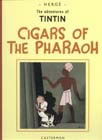
- Black & white facsimile / original version. Hardback.
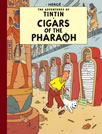
- Colour facsimile / 1955 re-drawn version. Hardback. June 2008. Egmont. 64 pages.
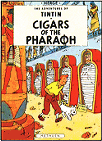
- Colour / 1955 re-drawn version. Hardback. Paperback. 64 pages.
- Tintin © Hergé/Moulinsart.
Original French title
Tintin en Orient / Les Cigares du Pharaon
Publication history
First published in Le Petit Vingtième between 8/12 1932 and 8/2 1934.
The book appeared in 1934 (B/W, 124 pages). Redrawn in 1955.
English edition
1971 - Methuen (London). Translated by Leslie Lonsdale-Cooper and Michael Turner. Colour. 64p. 31cm. ISBN: 0416088309.
1990 - Mammoth (London). Translated by Leslie Lonsdale-Cooper and Michael Turner. Colour. 64p. ISBN: 0749704640.
2006 - Casterman (Bruxelles). Translated by Michael Turner and Tessa Harrow. Black and white facsimile. Hardback. ISBN: 2203797037.
2008 - Egmont (London). Colour facsimile. 64p. 30x23cm. Hardback. ISBN: 9781405240710.
Related link
First publication dates of The Adventures of Tintin
Plot
Scores of Egyptologists have tried to find the lost tomb of the Pharaoh Kih-Oskh; every single one has vanished. When Tintin and Snowy meet the eccentric Egyptologist, Doctor Sarcophagus, they are soon involved in the search themselves—and find that the tomb contains a more sinister secret than sand and mummies. Following the clue of a mysterious symbol on a cigar band Tintin and Snowy clash with a gang of drug smugglers are off on a dizzy chase to Arabia and India, plunging headlong into another dangerous battle of wits with an international gangster. [AR]
Review
By Bruno Bollaert
Les Cigares du Pharaon fully marks the transitional period towards Hergé's second stage in the development of Tintin. Although the setting of the album fits within the 'global cycle' of the first three albums (Russia, Africa, America, and now the Orient), the album title no longer refers to the geographical location of Tintin's adventures. When the new story was started on 8 December 1932 in Le Petit Vingtième, it was still entitled Tintin en Orient, but Hergé clearly wanted something else and turned to the more exciting and promising title of Les Cigares du Pharaon.
This album introduces Dupont and Dupond (Thomson and Thompson) although they have; already appeared in the background of the opening scene of Tintin au Congo. In Les Cigares du Pharaon the detectives did not have a name yet; but instead were referred to as X33 and X33bis (X33 and X33A in English). Several other characters make their first appearance in this album: Rastapopoulos, Allan Thompson, and Olivier da Figueira. Rastapopoulos and Thompson will become Tintin's enemies; da Figueira - a very convincing salesman to say the least—will become one of Tintin's friends. Finally, Philémon Siclone is the first prototype for the later Professeur Tryphon Tournesol (Cuthbert Calculus). In contrast with the previous albums, Les Cigares du Pharaon is more than just an amalgam of events. It is clear that Hergé tried to devise a proper plot, and the album even has a plausible ending. One of the weaknesses in the plot is the way in which Tintin travels from Egypt to India: in order to make this transition plausible, Hergé lets Tintin travel by train, where he meets, not only Philémon Siclone, but also our two detectives. Furthermore, in the 1934 version traces of sensationalism (Hergé needed a cliff-hanger for his weekly episodes) can still be seen, but in the redrawn 1955 version Hergé made sure those irrelevant scenes were removed.
The story was clearly influenced by the discovery of the tomb of Tutankhamen by archeologist Howard Carter in 1922. The mysteries surrounding the tomb and Egyptian pharaohs would keep haunting Hergé, and led him to reuse some of the material for Les Sept Boules de Cristal. There was yet another influence: Paul Jamin (a friend of his brother). When Hergé met him, he was so impressed with Jamin's artistic qualities and his sense of humor, that he hired him on the spot. Jamin helped Hergé with his work for Le Petit Vingtième, where, thanks to Jamin's boldness and humor, even Hitler was not spared of ridicule.
Trivia
-
Cameos:
- Album cover: The Mummy marked E. P. Jacobini is E. P. Jacobs. [TT]
- Album cover: The Mummy marked Grosgrab is Professor Grossgrabenstein from one of Jacob's books.
- Page 8, frame 1: The Mummy marked E. P. Jacobini is E.P. Jacobs. [TT]
- 1955 edition: cover - one of the mummies is E.P. Jacobs named E.P. Jacobini. [TT]
- Page 9: one of the mummies is E.P. Jacobs named E.P. Jacobini. [TT]
- Tintin meets Rastapopolous for the first time in this album. But oddly enough, after his encounter with Rastapopoulos on the ship on page 4 (frame 5), Tintin says: "Rastapopolous?... Rastapopolous? Ah! I've got it: the millionaire film tycoon, king of Cosmos Pictures... And it's not the first time we met..."
Below are some comments from our readers:
a) There is nothing strange about Tintin's comment: Rastapopoulos has already made an appearance in Tintin in America (page 57, frame 5).
b) Ah, but is that really Rastapopoulos in Tintin in America?
In the French original, Tintin says: "En effet, ce n'est pas le premier venu" (translation: Indeed, he is not some man in the street). As a reporter, Tintin would obviously have heard of the famous tycoon; therefore one cannot infer that Tintin and Rastapopoulos have met before. [AD, ET, GN]
c) Simple: Tintin remembers that Rastapopoulos is a famous figure and realizes he has made a powerful enemy for himself. [JN]
d) You all think too much: Hergé changed the dialogue when he redrew the album in 1955, so that new Tintin readers already familiar with Rastapopolous would not be confused. - On page 8, frame 2, the coffins reserved for Sarcophagus (Philémon Siclone), Snowy and Tintin are labelled: 20, 20A and 21. This suggests the villains think that Snowy belongs to Sarcophagus.
- On page 10, the boat that picks up Tintin and Sarcophagus's coffins is captained by Allan (Captain Haddock's corrupt first mate in The Crab with the Golden Claws). In the 1934 black and white edition, there is no Allan.
- On page 12, frame 7, the Morse code reads: "FKNEMDS(?)". [TT]
- Thompson and Thomson make their first appearance in this story (page 13, frame 4). In the 1933 edition, the detectives are called X33 and X33A (X33 and X33 bis in French) - see page 23, last frame.
- On page 15, last frame, Sheik Patrash Pasha shows Tintin a Tintin book - Destination Moon. In the black and white version (both Petit Vingtième version and the book), the shik was showing what was at the time the most recent Tintin adventure (i.e., the black and white version of Tintin in America). In the colour version of the book from 1955, this was changed to Tintin in the Congo. However, there are several versions of the colour book with minor changes; e.g., the map and dialogue on page 1 (an Asian trip in some versions, but a Mediterrean trip in others), and an early edition mistake on page 52 where Snowy is by Tintin's side in the palace when he is still with the Thompsons at that time (Snowy was removed in later editions). When some of these changes were made, Tintin in the Congo was replaced by Destination Moon on page 15. [MU]
- On page 16, Tintin interrupts a film shoot. The scene he interrupts is part of the movie he will see in his next adventure in Shanghai (The Blue Lotus, page 33, frames 4 and 5). [TT]
- On page 16, frame 11, Snowy chases after one of the actors away; but a split-second later in frame 12, Snowy is standing next to Tintin. On page 17, panel 3, he is shown returning from chasing the Arabs, carrying a piece of clothing in his mouth. [G and MT]
- On page 23, frame 3, Tintin is attacked in the desert. He drops his flask which cannot be seen in frames 4 and 5. However, the flask is back in sight with its strap under Tintin's elbow in frame 8. [DT and MT]
- On page 26, in the French version, Tintin enlists under the name Beh-Behr. According to Marc Dufour of Montréal, Beh-Behr is simply a badly ortographed version of "Bébert", an affectionnate French diminutive of "Albert"--just as "Tintin" is a diminutive of "Martin". However, Hemutia, a Tintin fan from France, disagrees: he thinks Beh-Behr is a deliberate play on the name Robert.
In the English version, Tintin uses the name Ali Bhai. As "Ali Bhai" is pronounced the same as the English word, alibi, meaning an excuse or claim that one was elsewhere when an act took place in a certain location, reader Harry (mundosman-at-aol-com) thinks this could have been added as a pun when the book was translated into English. - Real life Ali Bhai - Ali Bey? Ali Bey (real name, Doménec Badia i Leblich) was a Catalan spy-reporter-adventurer. He was born in Barcelona, in 1767 and died near Damascus in 1822. Bey, heavily disguised, managed to make the muslim journey to Mecca. After returning to the occidental world, he was wanted for treason and was almost discovered in Constantinople in 1807. He managed to escaped to France. His book "Travels" was first published in French in 1814 and later in Spanish in 1836. [CK]
- On page 26, panel 9, as Tintin begins to sweep the office, the French version has it as the recruitment office (Bureau de recrutement). Yet on page 26, panel 1, it is the Colonel's office (Bureau du colonel). [MT and ET]
- On page 30, Tintin is with the Thompsons when they are informed by an Arab that the house is due to be raided by soldiers. Tintin is in his soldier's uniform. By the time he escapes the house, Tintin is back in his civilian clothes, including his plus-fours. [MT]
- On page 31, last frame, Tintin gets hold of a single engine, propeller driven aircraft somewhere in the middle of the Arabian Desert, after the "Ali Bhai" incident. He then escapes the chasing fighter aircraft and runs out of fuel, and crash lands somewhere in the Indian subcontinent. This whole sequence appears to last less than an hour. It takes a Boeing 747 around four hours to fly from Saudi Arabia to the Indian subcontinent; so how does Tintin achieve such a great distance in a single-engine aircraft, in such a short time?
[UPDATE: 27 July 2006 - Eric Dehais writes to say that Muscat to Karachi is 560 miles (896 km) - a stretch, but feasible.] - On page 50, frames 9 to 12 - how do Thompson and Thomson know where to find Snowy when the dog is about to be sacrificed to Sivah? [TT]
- When Hergé redrew the story in 1955, he ditched the long scene where Tintin fights some snakes. (Compare 1933 edition - pages 102-105 with 1955 edition - page 53.) [BP]
- On page 54, frames 3 to 5 - Tintin grabs the seventh brother in the "jungle Ku Klux Klan" and assumes his identity in order to infiltrate the meeting of the gang. This person's identity is never revealed in the revised edition. Relatedly, in frame 4 on page 56, six of the members of the opium gang are shown unmasked - what happened to the seventh member, the one whose robes Tintin is wearing? [AD]
- Hergé deleted all of the cliff-hanger endings from his original version when he redrew this story. [AD]
- In the original version, the captain of the ship on which the coffins containing Tintin, Snowy and Professor Sarcophagus are loaded is never seen. [AD]
- In the original version, Rastapopoulos sends Tintin to the dhow in order to investigate it. In the colour version, the captain is waiting for Tintin to return to his sailboat. [AD]
- In the original version, Tintin arrives at Mecca. In the colour version, he simply arrives at an Arabian town. [AD]
- Several scenes are lengthened in the colour version, including the sequence in which the coffins are loaded onto the ship. It is in this version that Allan appears as the captain. [AD]
- In the original version, after crashing in the Indian jungle, Tintin does not get the first aid kit or the manual, as he does in the colour version. [AD]
- On chasing the Fakir into the well under the hollow tree, Tintin - pistol in hand - enters a room in which a statue of Vishnu rises from the ground and cobras slither out of a hatchway in the statue's pedestal. He throws a chocolate bar at the cobras to distract them and escapes, narrowly avoiding a fall into a pit of crocodiles. It is after this that he grabs one of the drug ring and steals his hooded costume. This sequence was entirely omitted in the colour edition. [AD]
- In the 1934 edition, there are eight members of the ring assembled in the meeting room, instead of seven in the later edition. [AD]
- In the 1934 edition, when unmasked in frame 3 of page 110, one of the members of the ring is a Moroccan boatman seen earlier in the story. He is deleted in the colour version and only six of the gang are shown. [AD]
- In the 1934 edition, the Fakir escapes and tells Tintin and the Thompsons that in 3 minutes they will be blown sky high, but by the time they manage to pry the door open and escape, Snowy has urinated on the fuse attached to the barrels to put it out. This was also deleted in the colour edition. [AD]
- In the original version, in the final deleted sequence, the Fakir sneaks a cobra through Tintin's window as he sleeps, but Snowy puts on a record called The Snake Charmer that charms the snake, whereupon Tintin turns on the light and shoots him--also deleted. [AD]
- In the orginal version of the story, Tintin implies that Professor Sarcophagus is one of the gang in the last frame of that story; he added new scenes featuring the Professor in a floating coffin on the Arab Sea to the sequence in which Tintin awakens in his own floating coffin. The reason for this alteration was that the Professor was probably going to appear in The Blue Lotus as one of the gang members; The Blue Lotus did not go as Herge originally intended, and so Tintin's question about the Professor being one of the gang is thus rendered meaningless. [AD]
- According to reader Soumitra Nath, the Indian women featured in this album are wearing the traditional saree in the wrong fashion.
Title in other languages
- Basque - Faraoiaren Zigarroak
- Bengali - Faraoer Churut
- Bernese German - Em pharao siner cigare
- Breton - Segalennoù ar faraon
- Catalan - Els cigars del faraó
- Chinese - 法老的雪茄 (Falao de xuejia)
- Czech - Faronovy doutniky
- Danish - Faraos Cigarer
- Dutch - De sigaren van de farao
- Farsi/Persian - Sigar, hayi fir'awn
- Finnish - Faaraon sikarit
- Galician - Os xarutos do faraón
- Georgian - ფარაონის სიგარები
- German - Die Zigarren des Pharaos
- Greek - Ta Poura tou Farao
- Hebrew - Ha'sigarim Shel Ha'paronim
- Icelandic - Vindlar Faraos
- Indonesian - Cerutu sang faraoh [Indira edition title] / Cerutu Sang Firaun [Gramedia edition title]
- Italian - I sigari del faraone
- Japanese - ファラオの葉巻 Pharaoh no hamaki / Farao no hamaki
- Latin - De sigaris pharaonis
- Lëtzburgesch - Dem Pharao seng zigaren
- Norwegian - Faraos sigarrer
- Polish - Cygara faraona
- Portuguese - Os charutos do Farao
- Russian - Sigary faraona
- Serbo-Croatian - Faraonova cigara
- Slovenian - Farao nove cigaro
- Spanish - Los cigarros del faraon
- Swedish - Faraos cigarrer
- Turkish - Firavunun Purolari
- Vietnamese - Nhung dieu xi ga cua vua ai cap co bai